This is an overview of my work for my Graduate Certificate in Learning Design Leadership. These posts focus on: learning design leadership, topics and trends in learning design, and upskilling in learning design.

Learning Design Leadership
Leadership Dashboard: Driving Learning Design through Empathy and Planning
The dashboard on a vehicle is designed to display important information; in the spirit of this, I have designed a leadership dashboard to showcase the salient pieces regarding my leadership beliefs, style, and practices. It is reflective of my growth as a leader across a semester of coursework in learning design leadership.
My leadership philosophy revolves around the idea that any person at any level of an organization can be a leader. Meaningful change does not always have to come from the top and work down to the lower levels of an organization; sometimes, change can occur on a small scale at the bottom and then work its way up. I show this idea in action in my leadership philosophy.
In addition to my belief on the possibility of leadership from the bottom-up, I believe that empathy, active listening, and creating a sense of psychological safety are integral tools for a leader. As part of this, I propose that leadership is most effective when collectively shared. However, I also acknowledge that for efficient follow through on projects, plans, and management, roles and responsibilities must be clearly defined no matter what style of leadership is employed. At times, it is appropriate to have a central leader that others report to. My work in the dashboard reflects this tension between my belief in collective leadership and the knowledge that sometimes one person must take the lead.
My global vision for learning experience design, curated illuminated leadership plan, and community canvas all highlight my work as one central leader. However, within these examples the time I took to understand those I was designing for and leading is clear. The communication example, coaching and feedback plan, and project scope all highlight the importance of gathering information on and communicating with relevant stakeholders to create designs and projects directly tailored to group needs. The prototype for the professional development and curated illuminated leadership plan showcase my ability to lead in a collective and also as an individual. In these plans, I clearly define expectations, roles and responsibilities, and set manageable timelines.
Throughout my work, empathy, active listening, and willingness to work with others in order to achieve results is key. I make it clear in my coaching plan that I value input from others and that feedback is not a one way street. Instead, as I help others to grow through active listening, empathy, and constructive feedback, I expect those I lead to be able to communicate likewise to me. I do this through offering specific times, templates, and opportunities for feedback.
Leadership is a role where continual growth is necessary to lead effectively, create meaningful change, and continuously become a better leader. This leadership dashboard reflects my growth over one semester of graduate school; by utilizing my principles and continuously seeking feedback, I look forward to my continued growth as a leader in learning experience design.
References
Center for Creative Leadership. (2025, September 25). The 6 principles of leadership coaching, based on assessment – challenge – support. Center for Creative Leadership. https://www.ccl.org/articles/leading-effectively-articles/the-six-principles-of-leadership-coaching/
Hacking HR Team (2024, May 30). Empathy in action: A leadership toolkit for the modern workplace. hacking HR. https://hackinghrlab.io/blogs/empathy-leadership/.
Meyerson, Debra E. (2008). Rocking the boat: How to effect change without making trouble. Harvard Business Press.
O’Neil, C. & Brinkerhoff, M. (2018, February 1). Five elements of collective leadership. NPQ.
Leading with Understanding and Thought
I have mixed feelings about the word leadership. I have known leaders who have sat in their metaphorical ivory towers and dispensed media-ready quotes about the wonders of the organization and handed out plans while being completely unaware of the daily realities of those under their leadership. I have also known leaders who have joined in the daily work, though the hard work and dedication of these leaders has not been enough to erase the negative connotation of leadership in my mind. I have always valued leaders who took the time to listen to me, understand my perspective, and worked with me for a common goal. As this is what I value in a leader, this is what I strive for in my own leadership.
Above all else, the ability to show empathy and create psychological safety is vital as a leader. The people you lead need to know they are valued as people, not only as employees (Center for Creative Leadership, 2025). This can be done through teambuilding, active listening, and adopting a more egalitarian leadership model (Hacking HR Team, 2024). When I first took on a leadership role for a team at work, I spent a few minutes getting to know my team members. Then, at subsequent meetings I would inquire about what they had told me: a planned vacation or a child’s birthday for example. Acknowledging what mattered to my team members helped build rapport; my team worked more efficiently as a result (Hacking HR Team, 2024).
Building empathy also speaks to my belief in collective leadership. Rather than working top-down, my fast-paced work environment benefits from a more fluid structure. Though the need for clarity and organization will likely always necessitate someone to be the point person, collective leadership styles are more suited for the modern workplace as it allows for responsibility to be shared amongst team members (O’Neil & Brinkerhoff, 2018). This builds ownership, encourages self-efficacy, and allows for quick response to challenges (O’Neil & Brinkerhoff, 2018).
Collective leadership also speaks to my belief in leadership from the bottom-up. Though organizational change is often thought of as happening from the top-down, there is power in initiating change from the bottom-up (Meyerson, 2008). One change I made that has rippled outward through my school is my adoption of social-emotional learning (SEL) into my curriculum. When I first arrived at my school, many teachers were resistant to including SEL in their classrooms, as they felt it was merely one additional task administration had given them with little consideration for how it could actually be implemented. I believe in the value of SEL, difficult conversations, and growing as people. Therefore, I took the time to research quick ways to include aspects of SEL in my classroom. I shared what I found with my immediate colleagues, and then word slowly spread throughout the school. The following summer, I was paid by administration to develop a small SEL curriculum that could be adopted and adapted as needed for the entire school. It was my work as a teacher that allowed my organization to make meaningful change.
Though I believe all team members should have the ability to demonstrate leadership and take ownership of their projects, there are times and places where having a clear leader is necessary. The development of a project is one such time. Though execution of the project can be distributed throughout team members, it is often more efficient for one person to set up a project proposal, structure, and plan (WeLearn, 2024). This ensures all team members know what is happening and who to report to in the event of a challenge. Furthermore, giving and receiving feedback is often better when there is a clear leader in charge of it. An effective leader knows how to give constructive feedback to elicit specific change among team members they are leading (Brown, 2018). Likewise, an effective leader also solicits feedback on their work as a leader to make changes to benefit the team.
I believe effective leaders are those that take the time to get to know those they are working with and for. From simple conversations designed to get to know team members and relevant stakeholders to soliciting feedback, good leaders are readily accessible. While leadership can be shared among a group of people to increase buy-in, efficacy, and productivity, a leader must know when they can bring organization and structure to improve efficiency. It is through my commitment to empathy, organization, and hard work that I continually strive to be the type of leader others want to emulate.
References
Brown, B. (2018, October 15). Clear is kind. Unclear is unkind. Brené Brown.
Center for Creative Leadership. (2025, September 25). The 6 principles of leadership coaching, based on assessment – challenge – support. Center for Creative Leadership. https://www.ccl.org/articles/leading-effectively-articles/the-six-principles-of-leadership-coaching/
Hacking HR Team (2024, May 30). Empathy in action: A leadership toolkit for the modern workplace. hacking HR. https://hackinghrlab.io/blogs/empathy-leadership/.
Meyerson, Debra E. (2008). Rocking the boat: How to effect change without making trouble. Harvard Business Press.
O’Neil, C. & Brinkerhoff, M. (2018, February 1). Five elements of collective leadership. NPQ. Venngage Inc. (2025, August 18). 10 Leadership Styles Infographic [Image].
WeLearn. (2024, November 1). Agile project management in instructional design: How to streamline processes for efficiency and innovation. WeLearn. https://welearnls.com/agile-project-management-in-instructional-design-how-to-streamline-processes-for-efficiency-and-innovation/.
Current Topics and Trends in Learning Design
Connecting Liberatory Design Artifacts
This semester-long project combined two frameworks of design to ideate, research, prototype, and revise a solution to a perceived problem in my workplace. The analysis, design, development, implementation, and evaluation or ADDIE design model is useful because it fits a variety of instructional designs. This makes it ideal to use in the business or education world. While a newer model, Liberatory design nicely aligns with ADDIE in that ADDIE provides a more stable framework by which to apply the equitable and just principles of design that the Liberatory framework brings. Liberatory design aligns with my ethos as a teacher, facilitator, and designer, and ADDIE provided an excellent backdrop in which to move the project forward. Overall, the combination of the two allowed me to build a holistic picture of my school and stakeholders involved in order to co-design a thoughtful and equitable solution to a problem. The following posts will take you through brainstorming to prototyping and finally reflection on the process.
Learning Experience Design Technology and History
These infographics were created as a way to summarize key concepts — historical and technological — related to the field of learning experience design. The first infographic was created without the use of AI, and it synthesizes information from sever courses I took as part of my master’s degree: Learning Psychology, History of Assessment, and Current Topics and Trends in Learning Experience Design. The second infographic was created with the generative AI site Venngage. This was done to explore the challenges and opportunities for human and AI design.
Infographic One: Human Created
Infographic Two: Created with the Assistance of Generative AI
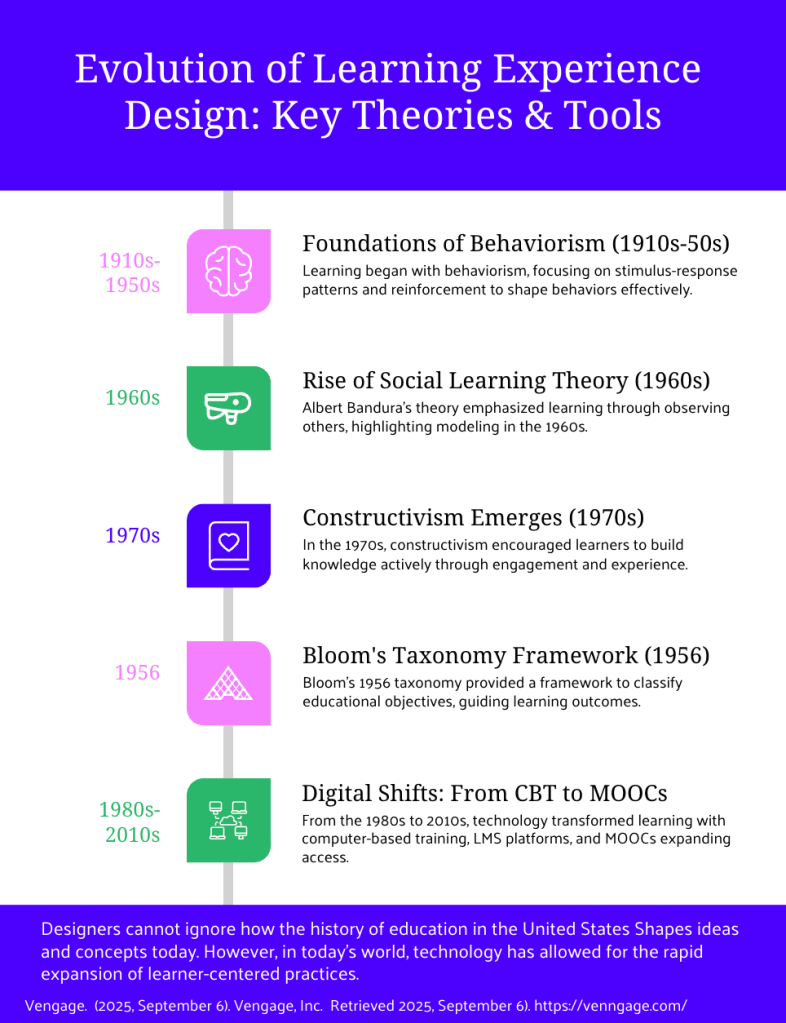
When designing on my own, it was difficult to narrow down all of the information I wanted to include into an infographic format. More than once, I caught myself wishing I had the chance to write this in a paper so I could explain my thinking more clearly. However, working on my own without generative AI assistance makes me take more pride in my work. It also allows me to know exactly where my information comes from, thereby identifying potential biases in sources and making sure I can attribute credit when needed. However, generative AI is more concise than I am. It is also able to effortlessly align elements and select accessible fonts and colors on the first try. However, it does not cite where its information comes from. It is also unable to generate its own thoughts, and requires human interaction to add the necessary reflective component for this design work.
Remixed Learning Model
My first video was made with Venngage’s Accessible Color Palette Generator, Canva, Camtasia, and Google Docs. I started with Canva to make a diagram, created a slides deck and added transitions. Then, I used Camtasia to screen-record my presentation while I read aloud from a script I wrote on Google Docs.
I like the control with manual video generation. Though some of the transitions are not the smoothest – the sliding text on the assessment slide for example – I like piecing together the different elements. Manual creation allows me to follow general WCAG guidelines and bring my full wealth of knowledge as a teacher to sharing knowledge in a concise format. Though more time-consuming than generative AI, I like the personalized human touch.
My second video was made with Biteable. As the purpose was to use generative AI, I started with the Video Assistant generator. I then added my own script, since I had one from the first video, and asked it to use a female voiceover. Then, in the video editor, I added additional slides and clarified text to make sure the video went through the main points of my remixed learning model.
It was definitely odd hearing a generic voice saying my name; and the initial video was nowhere near as in-depth as my manual video. It also failed to display my sources, and required several rounds of prompting before I realized the video generator would not accept my formatted references and I had to manually add a source slide. However, with some editing, I like the concise nature of the generative AI video.
Overall, there are benefits to both manual and automated video methods. The concise nature of a generative AI helps me focus my attention on the most salient points, and cuts down on time finding media and making transitions. The manual nature of Canva allows me full creative control, adding a human touch that is important to me, especially given the focus of my learning model on equity and social justice.
Upskilling in Learning Design
Under construction, come back later!
 Holly English